

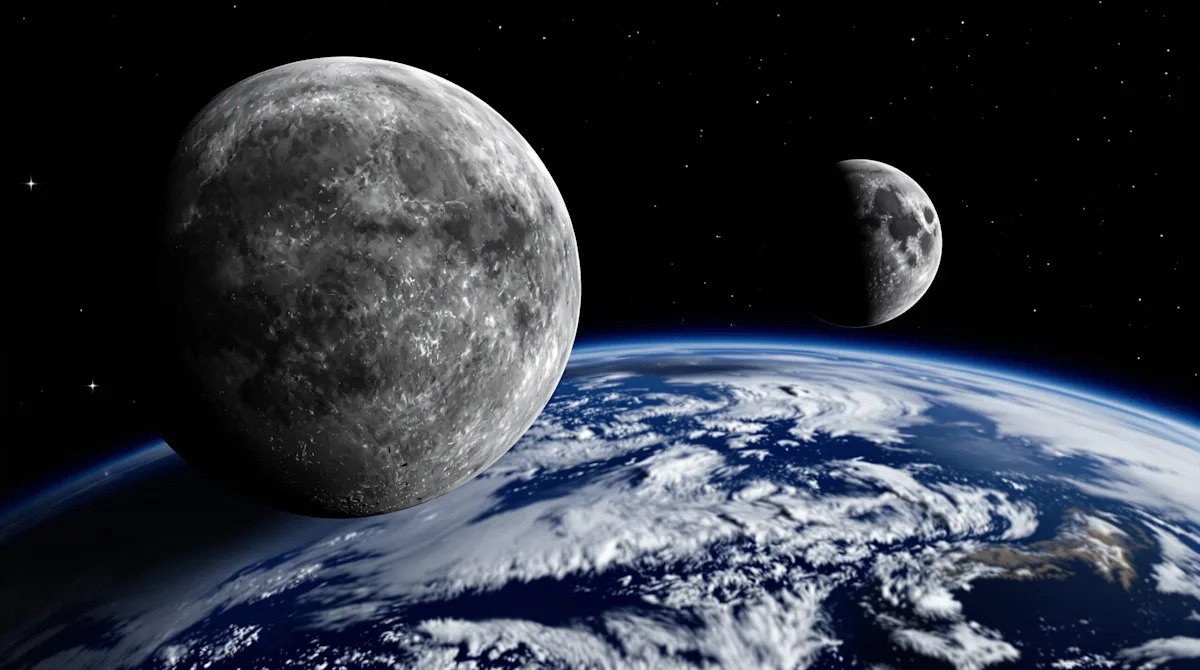
NASA has confirmed a fascinating development in Earth’s orbital dynamics. Earth is currently hosting a second celestial body, an asteroid designated 2025 PN7. This small object has been classified as a “quasi-moon.” It will accompany Earth in its orbit until approximately 2083. This report delves into the details surrounding this astonishing discovery and its implications.
**Understanding Quasi-Moons**
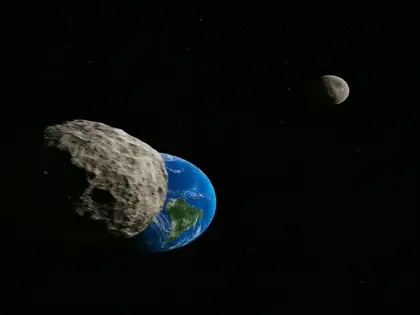
Quasi-moons are unique celestial objects that share an orbit with a planet but do not technically orbit the planet itself. The asteroid 2025 PN7 has been traveling alongside Earth for about 60 years. It has a size ranging from 18 to 36 meters, comparable to a small building. Unlike our Moon, which is gravitationally bound to Earth, 2025 PN7 resembles a friendly runner keeping pace on the same track.
**NASA’s Findings**
According to a report from NASA, 2025 PN7’s orbit closely mirrors that of Earth. It appears to shadow our planet as we both revolve around the Sun. The asteroid’s trajectory is influenced by the gravitational forces of the Sun and nearby planets, leading to its unique orbital behavior.
NASA’s research indicates that this quasi-moon will remain in Earth’s vicinity until 2083. At its closest, it approaches within 4 million kilometers, which is about ten times the distance to our Moon. At its furthest, it can drift out to 17 million kilometers.
**Implications for Science and Astronomy**
The classification of 2025 PN7 as a quasi-moon opens new avenues for scientific exploration. This phenomenon presents a rare opportunity to study the interactions between celestial bodies. Researchers can gather valuable data about the asteroid’s composition and behavior during its time in Earth’s orbit.
Phil Nicholson, a professor of astronomy, provided insight into the nature of quasi-moons. He described them as celestial companions that can be observed from Earth, albeit without a true gravitational connection. This dynamic allows scientists to study these objects while understanding their role in our solar system.
**Conclusion**
NASA’s confirmation of the existence of a quasi-moon, 2025 PN7, is indeed exciting. Earth’s celestial neighborhood is more dynamic than previously thought. With this asteroid accompanying us until 2083, researchers have a unique opportunity to deepen our understanding of orbital mechanics and the behavior of small celestial bodies.
As we look forward to the coming decades, the study of 2025 PN7 may reveal secrets of our solar system. The next few years promise to be rich with discoveries that enhance our knowledge of the cosmos. The “nasa two moons earth” phenomenon is not just a curiosity; it’s a doorway into the mysteries of space.
**References**
1. “Two Moons, One Picture – NASA Science.” NASA, [link](https://science.nasa.gov/resource/two-moons-one-picture/).
2. “NASA Confirms Earth Now Has Two Moons Until 2083.” Yahoo News, [link](https://www.yahoo.com/news/articles/nasa-confirms-earth-now-two-213956357.html).
3. “Will Earth Have Two Moons Orbiting It? Astronomers Explain the ‘Quasi-Moon’.” ABC News, [link](https://abcnews.go.com/US/earth-moons-orbiting-astronomers-explain-quasi-moon/story?id=126770774).
4. “Earth Now Has Two Moons, At Least Until 2083 – And NASA Confirms It!” Times of India, [link](https://timesofindia.indiatimes.com/etimes/trending/earth-now-has-two-moons-at-least-until-2083-and-nasa-confirms-it/articleshow/124714781.cms).
ڷ
-
[1] Two Moons, One Picture – NASA Science
-
[2] NASA confirms Earth now has two moons until 2083
-
[3] NASA says Earth has two moons, sort of: Here’s what to know
-
[4] Will Earth have two moons orbiting it? Astronomers explain the …
-
[5] Earth now has two moons, at least until 2083 – and NASA confirms it …
-
[6] NASA confirms that Earth now has two moons until 2083
-
[7] BREAKING: The Earth now has two moons, as confirmed by NASA.